
As the digital printing industry continues to grow rapidly, competition is no longer focused only on printing speed or equipment performance. Instead, successful businesses are increasingly optimizing their entire production workflow, including production efficiency, material utilization, and overall operating costs.
For companies working with DTF printing, UV printing, sublimation printing, and other digital printing technologies, profitability depends on much more than simply purchasing low-cost consumables.
The key factors that directly impact production costs include:
Material compatibility and utilization efficiency
Equipment stability and uptime
Production waste control
Labor efficiency
After-sales service and maintenance costs
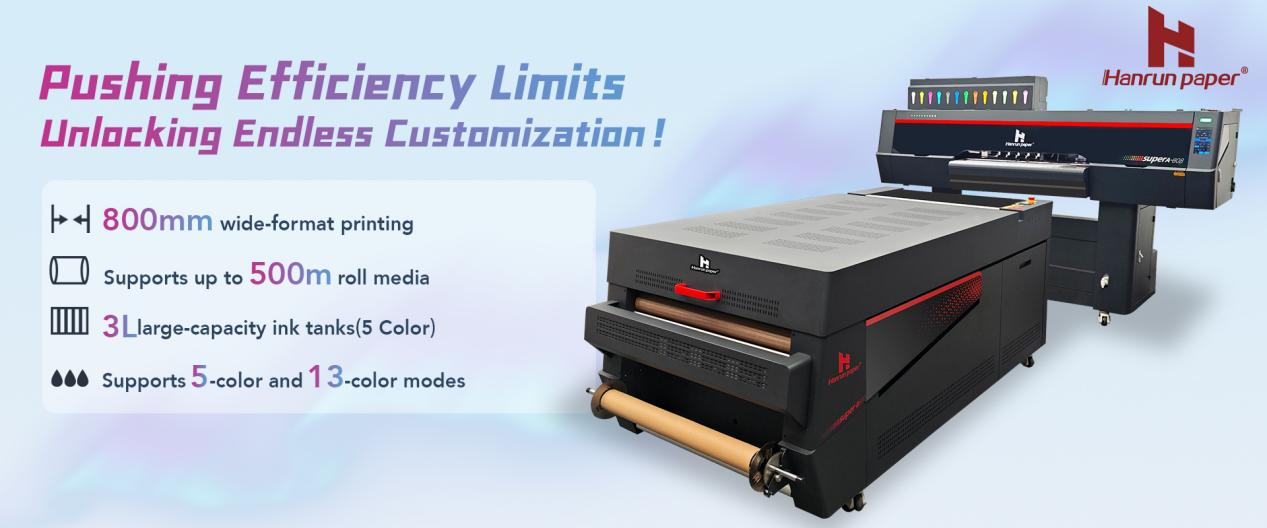
Taking DTF printing as an example, Hanrun Paper’s internal production analysis shows that for an A4 T-shirt printing application using the Super A-808 DTF printer, the overall production cost structure is approximately distributed as follows:
Garment cost (fabric and blank products): around 51% of total production cost
Consumables cost (DTF film, ink, powder, etc.): around 8%
Labor cost: around 20%
Equipment and fixed asset depreciation: around 20%
Electricity and other operating expenses: around 1%
Therefore, improving production processes and building a stable supply chain system have become essential strategies for digital printing companies seeking cost reduction and higher efficiency.
As a professional digital printing solution provider, Hanrun Paper focuses on customers’ real production needs — from material research and development, product manufacturing, to application support — delivering reliable and integrated digital printing solutions for global customers.
When purchasing digital printing consumables, many companies traditionally focus on individual product prices:
“How much does one roll of film cost?”
“How much does one kilogram of powder cost?”
“How much does one bottle of ink cost?”
However, in real production environments, a lower purchasing price does not always mean lower manufacturing costs.
The true cost of printing is determined by the entire production process, including:
Material compatibility
Printing stability
Production efficiency
Waste rate
Labor requirements
Maintenance frequency
A small issue in one production stage can create significant hidden costs.
Assume a DTF printing factory produces:
500 garments per day
Average production cost: $2.5 per garment
Material cost (film, ink, powder, etc.): approximately $0.2 per garment
If material compatibility issues cause 5% of products to require rework:
Daily additional loss:500 × 5% × 2.7 = $67.5
With 300 production days per year:$67.5 × 300 = $20,250 annual loss
This calculation shows that selecting stable and compatible materials is not only a quality decision — it is also a direct cost-saving strategy.
A reliable material system and standardized production workflow are critical for reducing long-term operational expenses.

In traditional digital printing production, many companies rely on multiple suppliers for different products, including:
Printing equipment
DTF films
Hot melt powders
Digital printing inks
Post-processing equipment
Related accessories
Although this purchasing model may appear flexible, it often creates hidden challenges during daily operations.
Common problems include:
Product compatibility risks
Inconsistent quality standards
Longer purchasing cycles
Unclear after-sales responsibilities
For growing digital printing businesses, managing multiple suppliers can increase operational complexity and reduce production efficiency.
A complete one-stop digital printing solution helps companies simplify supply chain management by integrating compatible products, standardized quality control, and technical support.
By adopting an integrated printing solution, production companies can significantly reduce unnecessary costs and improve workflow efficiency.
According to practical customer applications, a complete solution can help reduce:
20%-30% of supply chain communication costs
15%-25% of material testing time
10%-20% of inventory management pressure
Instead of separately managing printers, consumables, and technical issues from different suppliers, companies can build a more stable and efficient production system.
The DTF printing workflow includes:
Technical Support
Hanrun Paper’s UV printing solution includes:
Application Guidance

The sublimation printing system includes:

Material Compatibility: The Hidden Key to Improving Printing Efficiency
The final quality of digital printing is not determined by a single product.
Instead, it depends on the complete printing system:
Printing Equipment × Ink × Film/Paper × Powder × Production Parameters
Any unstable factor in this workflow may affect:
Color performance
Adhesion quality
Washing durability
Production efficiency
For DTF printing applications, optimized material combinations can help companies:
Reduce printhead clogging risks
Minimize white ink sedimentation issues
Improve transfer success rates
Reduce defective product rates
A complete and compatible material system allows businesses to maintain stable production quality while reducing unnecessary waste.
After optimizing consumable selection and production parameters, some customers achieved:
2%-5% improvement in first-pass product qualification rate
5%-15% reduction in material waste
More than 15% improvement in production efficiency
These improvements demonstrate that professional material matching and workflow optimization can directly improve business profitability.
For growing digital printing companies, expanding production capacity is not only about purchasing more equipment.
The biggest challenge is maintaining consistent product quality while increasing output.
A scalable production system requires:
Stable raw materials
Standardized production processes
Optimized printing parameters
Reliable technical support
Through a professional quality management system, Hanrun Paper helps customers establish a more efficient and controllable digital printing workflow.
Consistent printing performance starts with strict raw material control.
Hanrun Paper manages the complete process, including:
Raw material selection
Formula development
Batch inspection
Application testing
This ensures every product batch meets stable performance requirements before reaching customers.
For example, DTF hot melt powder requires different characteristics depending on application scenarios.
Hanrun Paper provides different powder solutions based on customer production requirements:
| Powder Type | Recommended Application |
|---|---|
| Fine Powder | Soft garments and high-stretch fabrics |
| Medium Powder | Standard apparel production |
| Coarse Powder | Thick fabrics and special materials |
| Anti-Sublimation Powder | Dark polyester fabrics and dye migration prevention |
By selecting the correct powder type, customers can improve transfer performance, reduce production failures, and achieve better finished product quality.
Beyond materials, production parameters also play an important role in printing performance.
With years of application experience, Hanrun Paper helps customers optimize key production settings, including:
Printing speed
Drying temperature
Powder application amount
Heat press temperature and pressure
Transfer time
For high-volume production companies, standardized parameters can significantly reduce trial-and-error costs.
After implementing standardized production settings, businesses can reduce:
New employee training time by approximately 30%-50%
Product adjustment time by approximately 20%-40%
A standardized workflow enables companies to train employees faster, maintain consistent quality, and expand production more efficiently.
The digital printing industry is moving from a traditional product-selling model toward a solution-based business model.
Today, customers are no longer looking for only a single consumable supplier.
They need a long-term partner who can help them:
✔ Reduce production waste
✔ Improve equipment utilization
✔ Maintain stable product quality
✔ Optimize supply chain management
✔ Respond quickly to market changes
As a professional digital printing solution provider, Hanrun Paper combines advanced R&D capabilities, comprehensive manufacturing systems, and global service experience to deliver integrated solutions for DTF printing, UV printing, DTG printing, and sublimation printing applications.
By integrating high-performance printing materials, professional technical support, and application expertise, Hanrun Paper helps customers reduce production costs, improve operational efficiency, and create long-term business value.
Hanrun Paper is committed to providing professional digital printing solutions for global customers.
With expertise in:
DTF printing materials and equipment
UV printing solutions
DTG printing applications
Sublimation printing systems
Hanrun Paper provides high-quality printing materials, reliable equipment solutions, and professional technical support to help businesses achieve more efficient and sustainable growth.
From product development and manufacturing to application support, Hanrun Paper works closely with customers to build complete digital printing workflows that improve productivity and competitiveness.

