
According to research data from Verified Market Reports Global UV Printer Market Size and Trends, 2026‑2034, the global UV printer market size will reach approximately USD 1.25 billion in 2026, and is projected to hit USD 2.83 billion by 2034, with a compound annual growth rate exceeding 10%. This indicates that a growing number of manufacturing enterprises are adopting UV digital printing technology to replace traditional processes.

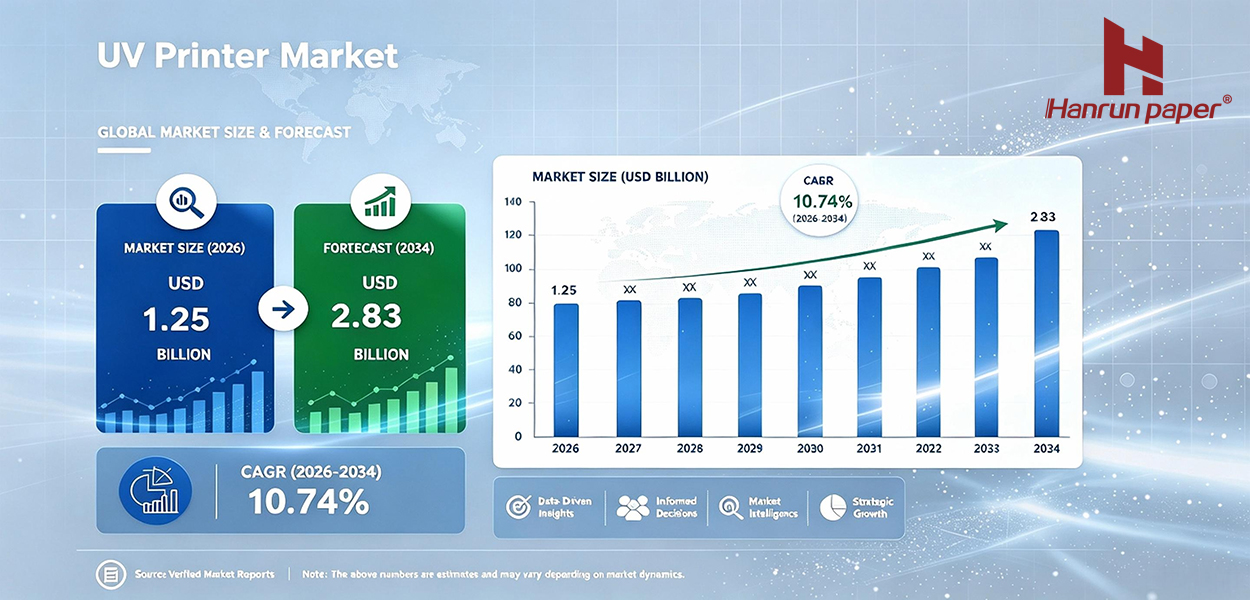
Image Source: Verified Market Reports
As industrial UV printing moves toward high‑efficiency and intelligent operation, enterprises no longer focus solely on printing speed when purchasing equipment. Greater importance is attached to stability, production efficiency, operating costs and long‑term return on investment. As a comprehensive digital printing solution provider, Hanrun Paper draws on years of industry practice and technical experience to analyse the core selection criteria for industrial‑grade UV printers from five dimensions: printhead configuration, printing stability, ink system, software support and after‑sales service, providing professional reference for enterprise equipment procurement.
The printhead is the "heart" of a UV printer, directly affecting printing accuracy, production efficiency and equipment service life. Currently, Ricoh Gen6 and Epson I3200‑U1 printheads are widely applied in the industrial market.
The Ricoh Gen6 printhead features 1280 nozzles, supports UV, aqueous and solvent‑based inks, and delivers a maximum firing frequency of 50 kHz. It achieves high‑quality output while enabling higher productivity. According to official Ricoh documentation, the Ricoh Gen6 printhead has been upgraded and optimised in dot placement accuracy, droplet uniformity and wear resistance, with an average service life of 3‑5 years, effectively enhancing stability during continuous production.
The Epson I3200‑U1 printhead adopts PrecisionCore MicroTFP technology, equipped with 3,200 nozzles in an 8‑row nozzle structure. It supports a maximum jetting frequency of 43.2 kHz, and variable droplet technology delivers fine droplet control, balancing printing precision and production efficiency. Epson official test data shows that the I3200 series features piezoelectric actuator durability of up to 106 billion cycles, providing a solid hardware foundation for long‑hour continuous printing.
Compared with retrofitted printheads, industrial‑grade printheads generally offer the following advantages:
Drawing on in‑depth experience accumulated over years in the industrial digital printing sector, Hanrun Paper reminds enterprises: when purchasing industrial UV printers, do not only compare equipment quotations. Pay close attention to core parameters including printhead brand, nozzle quantity, minimum droplet size and jetting frequency.
Stable equipment operation is far more important than simply pursuing printing speed. Frequent ink starvation, ink misting, nozzle clogging and unplanned downtime during production will delay delivery schedules and drive up labour and material loss costs. Therefore, continuous production capability must be prioritised when evaluating industrial UV printers.
Hanrun UV printers deliver stable performance under long‑hour, heavy‑load production:
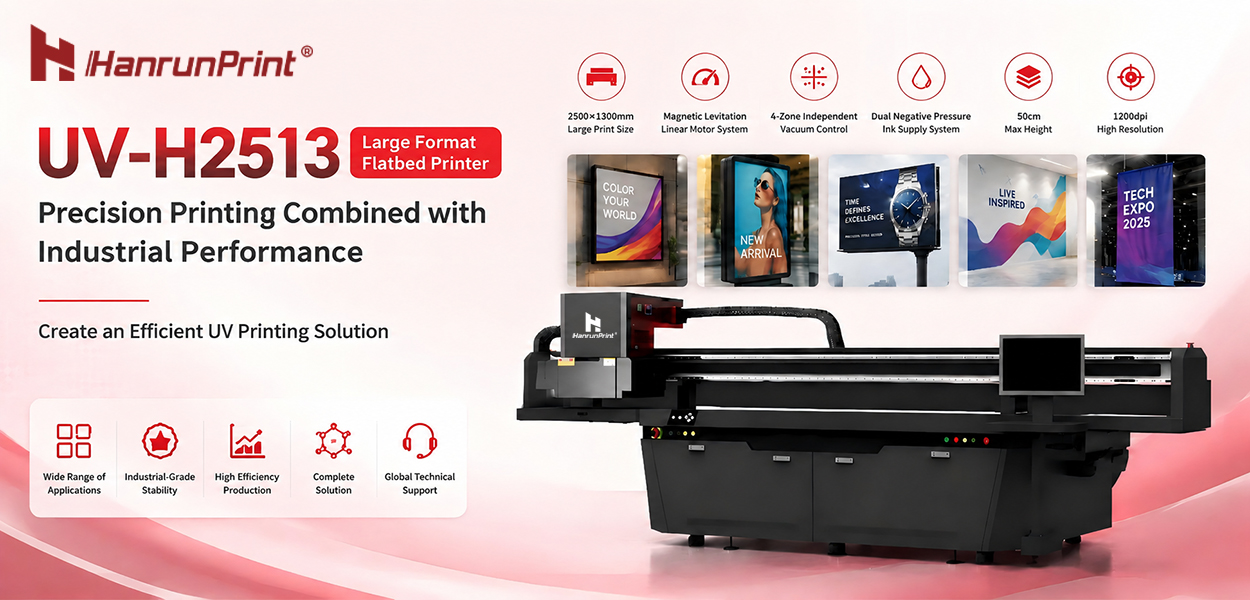
UV‑H2513 Optional configuration with 8 Ricoh Gen6 industrial printheads to maintain consistent dot placement accuracy over long production runs. Negative‑pressure ink supply system delivers precise pressure control and reduces nozzle clogging and ink starvation. High‑rigidity frame paired with magnetic‑levitation linear motors, supplemented by intelligent lifting and automatic height detection, suppresses mechanical vibration. Multi‑zone vacuum adsorption platform firmly secures materials to prevent printing deviations caused by material warpage and shifting.

UV‑H9060 Compatible with Epson I3200‑U1 / Ricoh Gen6 printheads. Dual negative‑pressure ink supply system guarantees high ink jetting accuracy and eliminates ink dripping and starvation. Equipped with an intelligent ink maintenance station to perform automatic printhead humidification, cleaning and sealing, keeping the equipment ready for operation at all times. Secondary cartridge heating works in tandem with an efficient water‑cooling system to maintain constant ink viscosity across all operating environments. Built with a 50×50×4 mm thick square‑steel frame and industrial dual‑screw drive system, it achieves repeat printing accuracy of 0.1 mm.


For industrial users, a truly valuable piece of equipment should deliver:
Leveraging nearly 20 years of profound technical accumulation in industrial digital printing, Hanrun Paper’s UV printer series fully meets the above‑mentioned industrial production requirements. Consistent and reliable production performance is the core guarantee for enterprises to cut costs and boost efficiency.
Public equipment technical documents from 2026 show that ink system design for industrial UV printers is evolving towards constant‑temperature control, precise negative pressure, multi‑stage filtration and white ink circulation. Models from Hanrun Paper including UV‑H9060, UV‑H1612, UV‑H3220, UV‑H2513 and UV‑H1806S adopt stable ink supply designs that mitigate ink supply fluctuations and white ink sedimentation risks via circulation, filtration and pressure control. Some industry‑available solutions feature constant‑temperature negative‑pressure secondary ink supply and three‑stage filtration; published specifications report temperature control of approximately ±1 ℃ and negative‑pressure fluctuation ≤ ±0.5 kPa.


Based on Hanrun Paper’s extensive industrial digital printing application experience, when selecting equipment, enterprises should look beyond ink tank capacity and assess:
A high‑efficiency ink system does not rely on excessive feature count; the key lies in coordination across all stages: Stable ink storage → Circulation and agitation → Precision filtration → Accurate ink supply → Uniform jetting → Automatic maintenance.
Beyond image output, industrial UV printers must handle colour management, layout processing, data processing and process automation. RIP software performance directly determines production efficiency and finished‑product consistency.
Hanrun Paper provides mature industrial‑grade RIP solutions compatible with mainstream software including ColorGATE and PrintFactory, supporting ICC colour management standards. Precise adjustment of ink volume, colour curves and printing parameters ensures consistent colour output across batches.
Core software ecosystem capabilities:
Hanrun Paper delivers an all‑in‑one solution integrating hardware, RIP software, colour management, commissioning and after‑sales support. It lowers operational barriers and mitigates quality deviations caused by human error.
The value of industrial UV equipment depends heavily on robust after‑sales support. Enterprises should evaluate overall all‑in‑one service strength during procurement.
Technical Training Hanrun Paper provides equipment commissioning, operational guidance and production training, supported by technical documents including UV Flatbed Printer Maintenance Guide and UV Ink Usage Notes, covering maintenance, troubleshooting and ink management. Remote video training and on‑site training are available.
Spare‑parts Supply Stocked core spare‑parts include Epson I3200‑U1, Ricoh Gen6 printheads, mainboards and ink system assemblies. All‑in‑one supply of consumables such as UV inks and films avoids production downtime caused by waiting for replacement parts.
Response Speed Multi‑channel support via phone, WeChat and email; remote diagnosis and on‑site service mechanisms are established. Preliminary diagnostic solutions are provided within 30 minutes for common issues such as ink starvation, print misalignment and incomplete curing. On‑site engineers are arranged within agreed timelines for on‑site faults, with 7×12‑hour online technical support.
Our all‑in‑one service has helped customers reduce fault‑related downtime by more than 30 %, double printhead service life, and cut overall operating costs by 15‑20 %.
As digital printing becomes industrialised and intelligent, the value of UV printers is no longer defined purely by price and speed, but by five core capabilities: printhead performance, equipment stability, ink system, software and services.
The 2026 Digital‑Intelligent Procurement Development Report shows that China’s digital procurement penetration rose from 11.5 % in 2024 to 11.8 %. Procurement models are evolving from standalone transactions toward supply‑chain collaboration and value‑oriented management.
Hanrun Paper has built a mature all‑in‑one service portfolio covering UV, DTF and sublimation product lines. The full‑lifecycle service chain spans equipment, inks, consumables and RIP software, through installation & commissioning, technical training, spare‑parts supply and after‑sales support. It delivers end‑to‑end assistance from equipment selection, installation and commissioning through stable mass production.
For enterprises engaged in industrial UV printing, long‑term value does not come from low‑cost equipment alone. It requires reliable equipment, complete accessory systems and consistent technical service. Hanrun Paper’s all‑in‑one solutions empower customers to achieve more efficient and stable industrial‑scale production.

